
Molecular Rotational Resonance (MRR) Spectroscopy Technology
Molecular rotational resonance spectroscopy (MRR) is a molecular analysis technology that enables structural identification and quantitation of gas-phase molecules through their unique rotational spectra. Because rotational spectra are directly determined by molecular structure, MRR provides highly specific molecular fingerprints that support confident compound identification, characterization, and measurement.
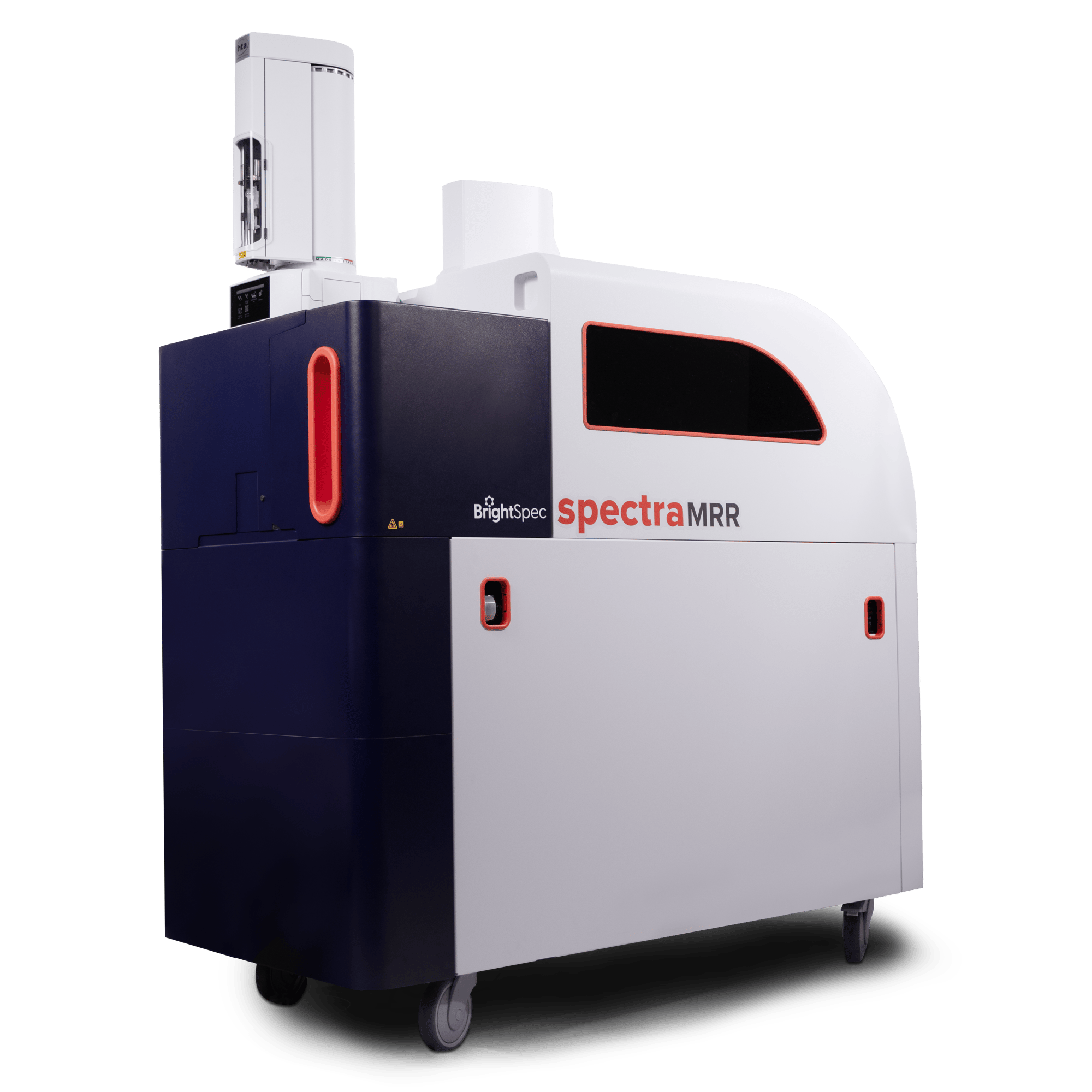
How Molecular Rotational Resonance Spectroscopy Technology Works
Molecular rotational resonance spectroscopy (MRR) works by exciting gas-phase molecules with microwave radiation and measuring the rotational transitions that occur as the molecules absorb and emit energy. Each molecule produces a unique rotational spectrum based on its three-dimensional structure, isotopic composition, and dipole moment. These highly specific spectra enable confident structural identification and quantitation of compounds in complex samples.

Rotational Spectra
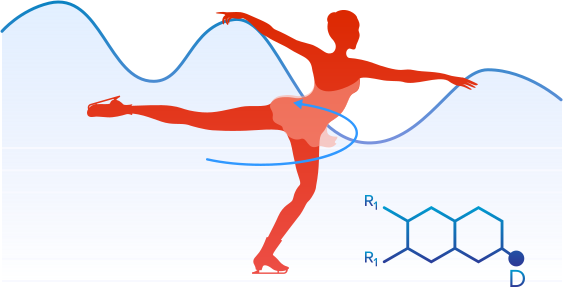
Rotational spectra are unique to a molecule's three-dimensional structure. Just as an ice skater's rotation changes with body position, even subtle structural differences between molecules produce distinct rotational spectra.

Spectral Simulation
Molecular structures and their spectra are simulated and validated using quantum chemistry, without the need for pure reference material. This capability is essential for validating AI-generated molecular designs, where novel structures have no existing reference spectra to compare against.
Selective and Quantitative
Using BrightSpec's platforms, these spectra can be measured with extraordinary specificity. Subtle changes
in the arrangement of a molecule yield unique quantifiable spectra.

See MRR in Action
Watch this short video for an overview of our molecular rotational resonance spectroscopy technology.
The Advantages of MRR
MRR delivers confident structural identification and quantitation from a single measurement.

Molecular Structure
MRR spectra are unique to the three-dimensional arrangement of atoms in a molecule.
High Resolution
Ultra-high-resolution spectra provide both specificity and selectivity directly from complex samples.

Quantitative
MRR spectra can be rapidly quantified for a highly specific assay.What Can Molecular Rotational Resonance Spectroscopy Analyze?
MRR analyzes molecules that possess a permanent dipole moment and can be introduced into the gas phase. Current BrightSpec workflows are particularly well suited for volatile and semi-volatile compounds, enabling direct molecular identification and quantitation without chromatographic separation. Because rotational spectra are directly linked to molecular structure, MRR can also distinguish many structurally similar compounds, including isomeric and stereoisomeric species.

Residual Solvents

Flavors & Fragrances
Chiral & Isomeric Compounds
Impurities

Industrial Chemicals

Pharmaceuticals

Natural Products

Process Monitoring
Frequently Asked Questions —Fundamentals & Comparisons
The GC-MS technique first chromatographically separates a mixture, then detects by mass-to-charge ratio. MRR needs no chromatography. It identifies and quantifies directly from complex mixtures based on 3D structure. MRR works with challenging solvents (including high-boiling-point and water-soluble acids) and saves roughly 40–70 minutes per sample versus traditional GC workflows, with no complex method development.
Molecular rotational resonance (MRR) technology offers several advantages, including molecular specificity, high resolution, quantitative analysis, minimal sample preparation, and the ability to simulate spectra directly from quantum chemical calculations. Because MRR spectra are unique to a molecule's three-dimensional structure, the technique enables highly specific identification. Its ultra-high-resolution spectra provide exceptional selectivity, even in complex mixtures, while rapid quantitation supports highly specific assays. Samples can often be analyzed directly without purification or scale-up, reducing preparation time. In addition, theoretical spectra can be generated without pure reference materials, enabling efficient validation and identification of analytes of interest.
Frequently Asked Questions —Working Principles & Extended Questions
For the spectraMRR and isoMRR instruments, samples are introduced via PTV liquid or headspace autosampler into the gas phase; the analyte undergoes supersonic expansion and is then excited with microwave radiation; rotational absorption/emission data are acquired in either broadband (full-spectrum - spectraMRR) or targeted (species-specific, spectraMRR and isoMRR) modes; structure proposals are validated through quantum-chemistry simulations and spectral fitting. Rotational frequencies are fingerprints of the molecule's 3D structure.
Resources
Learn more about BrightSpec's molecular rotational resonance (MRR) spectroscopy technology.

The Sleeping Giant Awakes: Defining a New Era of MRR Spectroscopy
Explore the fundamental technical advantages of MRR instruments and the technique's future development.

Learn how headspace-MRR directly quantified five key markers in fortified wine.

Meet the Full BrightSpec-MRR Product Portfolio
Explore the spectraMRR, isoMRR, nanoMRR, and consumable spectroscopy products.
BrightSpec Solutions
Explore how our instruments and consumables solve real-world analytical challenges across industries and workflows.